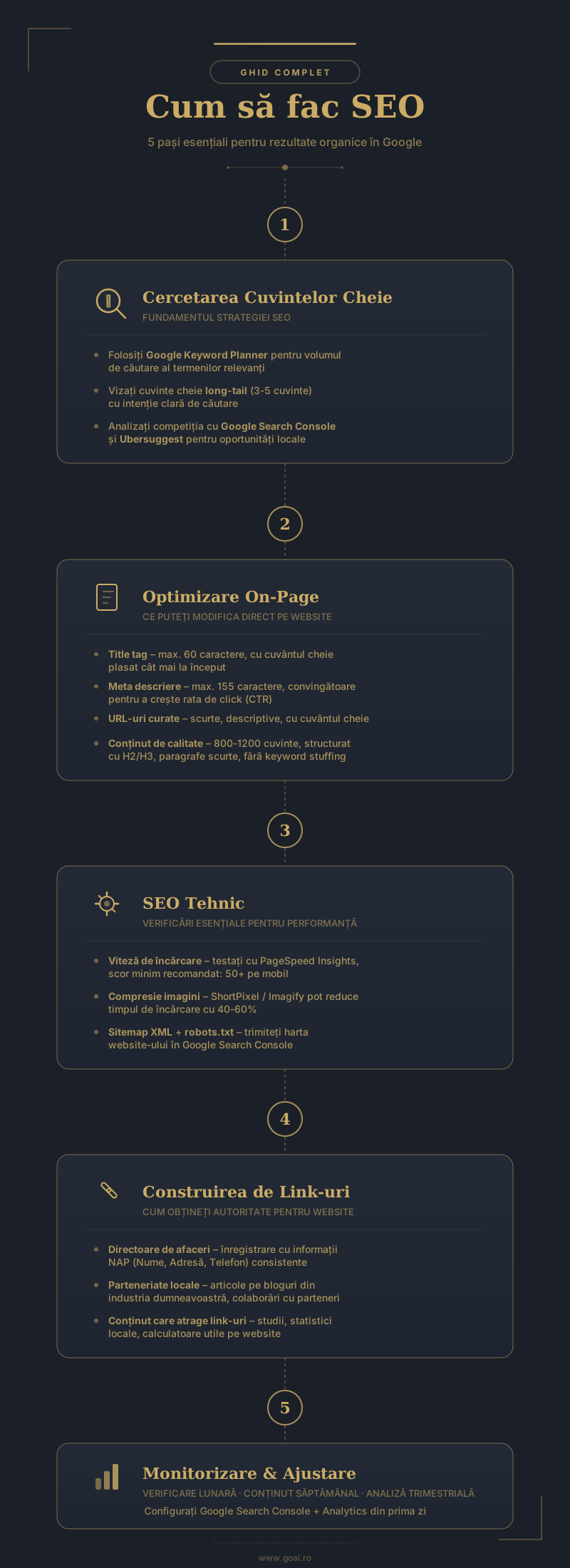
How to Do SEO: practical steps to bring your website to Google's organic results. If you have a website for your business and you're not receiving visitors from the Google search engine, the problem is not necessarily the lack of an advertising budget. Most of the time, the lack of organic traffic comes from a non-existent or incompletely applied SEO optimization service. The good news is that you can take the first steps yourself, even without advanced technical knowledge.
How to Do SEO
This article shows you, step by step, what website SEO optimization involves, from keyword research to technical improvements you can implement immediately. Each section contains concrete actions, not abstract theory. If you apply at least half of what you find here, your website will be in a visibly better position in Google's organic results within a few months.Keyword Research: the Foundation of Any SEO Strategy
Before you modify anything on your website, you need to know exactly what your potential customers are searching for in the Google search engine. Keyword research doesn't mean guessing terms, but using real data about search volume and competition level.Free Tools You Can Start With
You don't need expensive subscriptions to discover what your audience is searching for. There are several accessible tools that provide enough data to build a solid strategy.- Google Keyword Planner: available free in your Google Ads account, shows you the monthly search volume for any term. For example, if you have an auto repair shop in Cluj, you can check the volume difference between "auto service Cluj" and "auto mechanic Cluj-Napoca".
- Google Search Console: if you already have an indexed website, this tool shows you what keywords you already appear for, in what position, and how many clicks you receive. It's the most direct way to see where you are now.
- Ubersuggest: the free version offers a limited number of daily searches, but enough to identify low-competition keywords, ideal for local businesses.
How to Choose the Right Keywords for Your Business
The mistake most companies make is targeting very generic terms. An online shoe store in Brașov will never reach the first page for the phrase "shoes". But for "natural leather shoes Brașov" or "elegant men's shoes online order", the chances increase considerably. Focus on "long tail" keywords (longer phrases of 3-5 words). These have lower search volume, but user intent is much clearer.A person searching for "how to do SEO for online store" is closer to making a decision than someone searching only for "SEO".
On-Page Optimization: What You Can Modify Directly on Your Website
Once you have your keyword list, the next step is to ensure that each important page on your website is properly optimized. This is the part of SEO optimization that you control completely, without depending on external factors.
Titles, Meta Descriptions and URL Structure
Each page on your website has three elements that appear directly in Google's organic results: the page title (title tag), meta description, and URL. All three should contain the main keyword of that respective page.- Title tag: limited to approximately 60 characters. Place the keyword as close to the beginning as possible. Concrete example: "Auto Service Cluj | Engine Repairs and Computer Diagnosis" is better than "Welcome to our website - Auto Service".
- Meta description: approximately 155 characters. Doesn't directly influence ranking, but influences click-through rate. Write a sentence that clearly states what the user will find on the page and why it's worth clicking.
- URL: short, readable, with the keyword included. The format "your-website.ro/auto-service-cluj" is preferable to "your-website.ro/page?id=347".
Page Content: Quality, Not Quantity
The Google search engine evaluates your content based on how well it answers user intent. A 300-word text full of repeated keywords won't work. An 800-1200 word text that completely answers a specific question: yes. Structure content with H2 and H3 subtitles. Use short paragraphs of 2-4 sentences. Include the keyword in the first paragraph, in a subtitle, and naturally throughout the rest of the text. Don't force frequency: Google recognizes over-optimization and penalizes it. A practical example: if you have a cleaning company in Bucharest and write a page about "office cleaning Bucharest", include information about what the service involves, what surfaces you cover, what the recommended frequency is, and how to schedule. Answer the questions a potential client would have. That's it.Technical SEO Optimization: Checks You Can Do Yourself
The technical part scares many entrepreneurs, but most basic checks don't require programming knowledge. If your website is built on WordPress, Shopify, or another popular platform, you already have access to the necessary tools.Loading Speed and Mobile Experience
Google uses loading speed as a ranking factor. Test your website with Google PageSpeed Insights (free) and monitor the score for both desktop and mobile versions. A score below 50 on mobile means you're losing visitors and positions. The most common speed issues encountered on small business websites in Romania are: uncompressed images, WordPress themes with too many unused features, and lack of a caching system. Compress images with a plugin like ShortPixel or Imagify. Activate caching with WP Super Cache or LiteSpeed Cache. These two actions can reduce loading time by 40-60%.Website Sitemap and Indexing
A website sitemap is an XML file that tells the Google search engine what pages you have and how they are organized. If you use WordPress, a plugin like Yoast SEO or Rank Math automatically generates this file. Once you have it, submit it to Google Search Console, in the "Sitemaps" section.- Check indexing: in Google Search Console, "Pages" section, see how many pages are indexed and how many have errors. If you have 50 pages on your website but only 20 are indexed, you have a problem that needs to be solved.
- Robots.txt file: this file tells search engines what pages they are allowed to access. Check that you don't accidentally block pages you want to index. You can test the file directly in Google Search Console.
Link Building: How to Gain Authority for Your Website
On-page and technical optimization lay the foundation, but without links from other relevant websites, it's difficult to reach top positions for competitive terms. Google interprets each link to your website as a vote of confidence. Not all votes have the same weight.Accessible Link Building Methods for Local Businesses
You don't need complicated digital PR campaigns. As an entrepreneur in Romania, you have several direct and efficient methods available.- Registration in business directories: listeazafirma.ro, romaniayellowpages.com, firme.info and similar others. Make sure the information (name, address, phone) is identical on all platforms.
- Local partnerships: if you have a restaurant, propose an article on the blog of a local producer whose products you use. If you have an auto service, collaborate with a parts store. The link comes naturally from context.
- Content that attracts links: publish a study, local statistic, or useful calculator on your website. For example, an accounting firm can publish a tax calculator for freelancers. Other websites will reference this tool.
What You Should Avoid
Buying links from low-quality websites, massive link exchanges, and links from blog comments are practices that Google detects and penalizes. A penalty can mean complete disappearance from Google's organic results for months. It's worth building slowly, but correctly.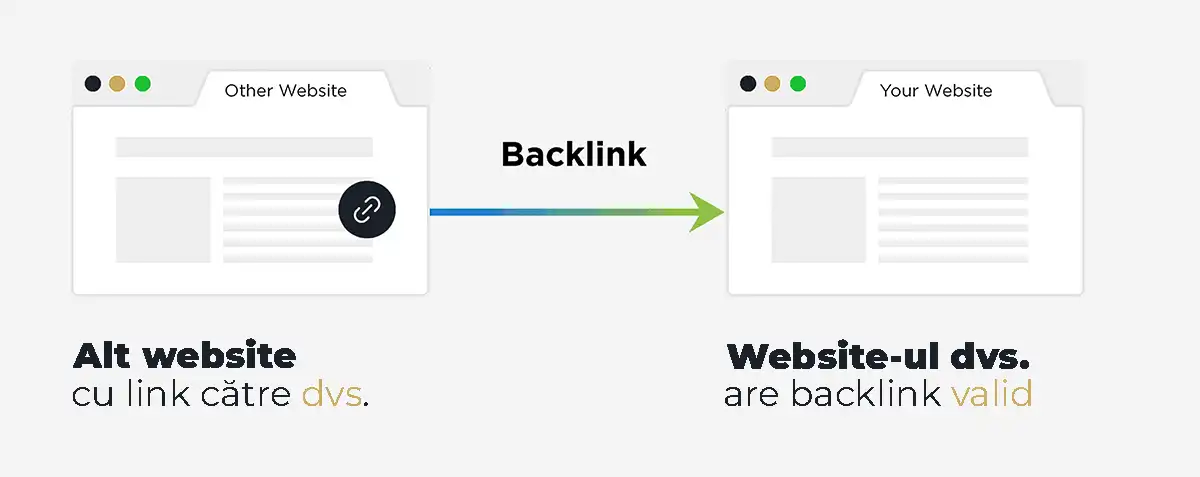
Continuous Monitoring and Adjustment of SEO Strategy
SEO optimization is not a project you finish and forget. It's an ongoing process. Google's algorithm updates several times a year, your competitors don't stand still, and user behavior changes. Set up Google Search Console and Google Analytics on your website from day one. Monitor monthly: what keywords you appear for, in what positions, how many clicks you receive, and which pages perform best. This data shows you where to invest effort going forward and where to abandon an approach that isn't working. Establish a rhythm: one technical check per month, one new or updated piece of content per week, one competitor analysis each quarter. You don't need an entire team. You need consistency and decisions based on data, not intuition. SEO optimization of a website is not complicated. It's methodical. Apply what you've read in this article, measure results, and adjust. The first visible improvements usually appear in 2-4 months. Those who have patience and discipline reach the first page: and stay there.How this article was made
- Author
- Dorel Tănase
- Published
- 23 February 2026
- Last updated
- 18 September 2026
- Sources
We work by our publishing principles, corrections policy, ethics policy.