An initial SEO audit is the map that guides your entire SEO optimization strategy for an online store. Don't view it as a boring technical task. See it as an investigation that uncovers both hidden opportunities and critical issues blocking your sales.
It's the first step, the fundamental one, to build a solid foundation for growth.
The Foundation of a Profitable SEO Strategy
Any effective growth plan starts with an honest analysis of the current situation. Without a correct diagnosis, you risk investing time and money in the wrong directions, fixing symptoms instead of causes. Think of the SEO audit as a vehicle inspection before a long journey: you want to know exactly what works perfectly and what needs immediate attention. To build a profitable strategy for your online store, it's essential to first understand what SEO means and how search engines fundamentally work. This context helps you correctly interpret audit data.
Where to Start Technical Analysis
The first concrete step is to use crawling tools to simulate how Google "sees" your site. Tools like Screaming Frog (which has a free version for up to 500 URLs) or Ahrefs' Site Audit are essential here. They scan every page, image, and link, generating a complete list of technical issues. Here's what you typically discover in this phase:
Crawl errors: Pages returning 404 (Not Found) or 5xx (Server Error) codes. These frustrate both users and Google's bots.
Duplicate content: A common issue in eCommerce, often automatically generated by sorting filters. For example, /shoes?color=red and /shoes?size=38 can create two URLs with identical content, diluting authority.
Missing or duplicate titles and meta descriptions: These are your free "ads" in search results. Their absence is a missed opportunity.
Unoptimized images: Product photos with large dimensions that drastically slow loading speed, especially on mobile.
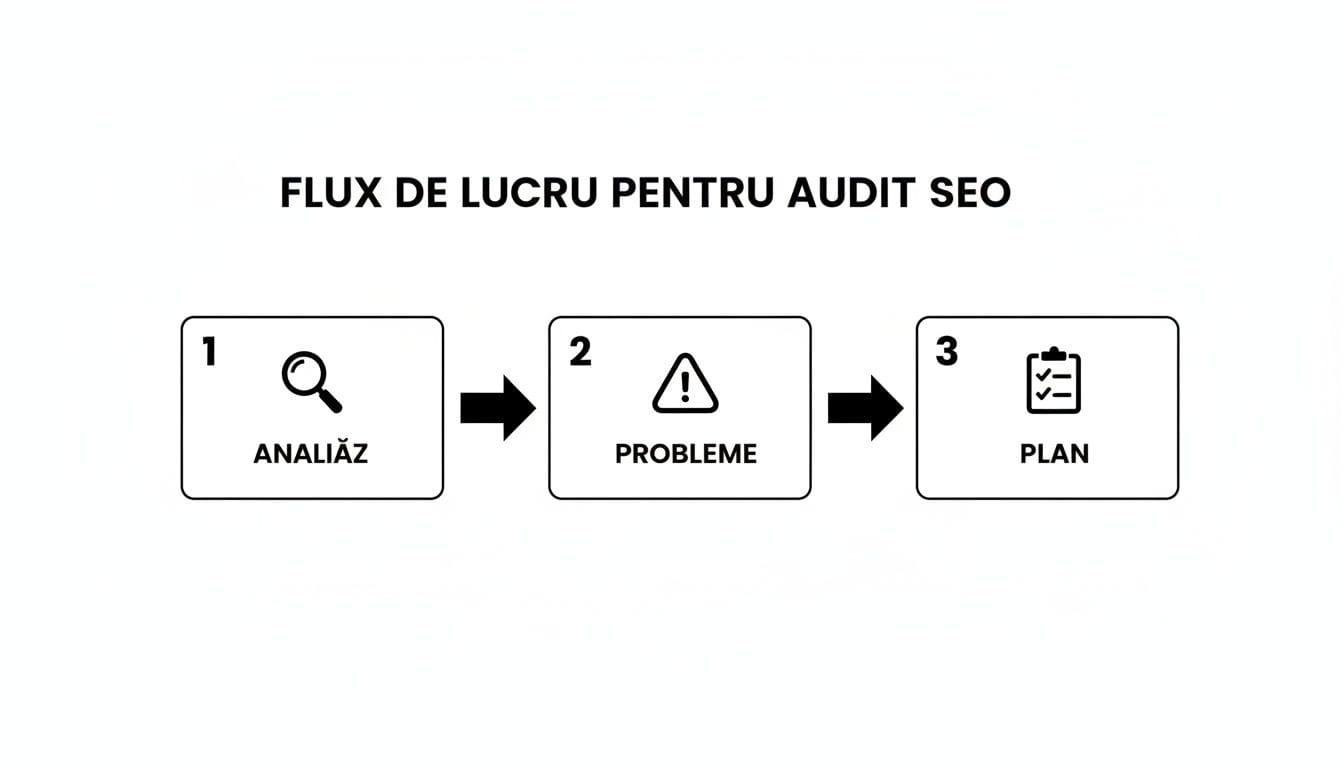
This workflow shows how raw data transforms into a concrete action plan.
The image above clearly shows: an effective audit doesn't stop at problem identification but culminates in a prioritized action plan.
Real Scenario: A Misconfigured robots.txt File
A client, an online cosmetics store, complained of poor sales for an entire new product category, despite significant investment in inventory and marketing. Organic traffic to those pages was nearly zero. During the audit, I discovered a single problematic line of code in the robots.txt file: Disallow: /new-products/. This directive, probably added by a developer during a testing phase and forgotten, explicitly told Google to completely ignore that section of the website. Dozens of products were practically invisible in searches.
By simply removing that line of code, the pages began to be indexed within days. In the first month, that category generated over €15,000 in sales, quickly recovering losses.
How to Prioritize Actions After an Audit
Once you have a complete list of issues, it's crucial to prioritize them. Not all errors have the same impact. Use a simple matrix based on two axes: impact on revenue and implementation effort. Problems with high impact and low effort should be at the top of your list. For example, fixing a wrong directive in robots.txt or adding unique titles for your best-selling products can bring quick results. At the other end, a complete site architecture rebuild is a high-effort project requiring long-term planning. At the end of this process, you'll have a clear roadmap. You'll know exactly where to focus your resources for the greatest ROI.
Discovering Keywords That Bring Customers
Choosing the right keywords is the foundation of any online store. Think of this process as choosing the right commercial location for a physical store; if you do it wrong, you end up talking to yourself, even if you have the best products on the shelf. An effective SEO optimization strategy for an online store doesn't stop at high search volume terms but goes deeper, understanding the real customer intent.
Understanding Customer Search Intent
Behind every Google search lies a specific need. Your job is to decipher that need and deliver the perfect answer. In eCommerce, search intent typically divides into three main categories.
Informational: The user is seeking information, not ready to buy. For example, "best winter boots" or "how to clean suede shoes". These keywords are perfect for blog articles.
Commercial (or investigative): The searcher is comparing products and exploring options, getting closer to a purchase decision. Terms like "women's leather boots reviews" or "Nike vs Adidas sneakers" fall here. Category pages or comparison guides are ideal for them.
Transactional: The customer knows what they want and has their card ready. Searches like "buy Nike Air Max 270 black size 38" or "Philips automatic espresso maker offer" signal clear purchase intent. These are golden keywords for product pages.
Ignoring this nuance is costly. Trying to rank a product page for an informational search is as ineffective as trying to sell something to someone just window shopping.
Concrete Techniques for Finding Valuable Keywords
To discover the terms your real customers use, you need to think like them. SEO tools like Ahrefs or SEMrush are excellent starting points, but creativity and empathy make the real difference. Start by creating a list of seed keywords (basic keywords). If you sell shoes, these might be "shoes", "boots", "sneakers". Then use tools to expand the list, searching for variations, synonyms, and questions people ask.
Don't underestimate the power of long-tail keywords. Terms like "waterproof winter boots for mountain hiking" have much lower search volume but exponentially higher conversion rates. Why? Because the user's intent is extremely specific and competition is reduced.
Consumer behavior in Romania shows growing dependence on search, especially for purchases. Data confirms that position #1 on Google benefits from a CTR (click-through rate) of 34.36%, demonstrating the immense value of top ranking for sales. Furthermore, 46% of all Google searches show local intent, and an amazing 78% of these searches lead to offline conversions.
Mapping Keywords to Store Structure
Once you have a solid list, the next critical step is to assign each keyword to the correct page. This process, called keyword mapping, helps you build a logical site architecture friendly to search engines.
General (broad) keywords: High-volume terms, such as "women's dresses", should target main category pages.
Specific keywords: More detailed terms, like "long velvet evening dresses", fit subcategories perfectly.
Long-tail (product) keywords: Very precise searches, such as "LaDonna black dress size M", should lead the visitor directly to that product page.
To identify seasonal trends and anticipate demand, it's vital to use tools that analyze search popularity over time. Understanding these fluctuations helps you adjust your inventory and marketing strategy. Learn more about how to benefit from Google Trends in your SEO strategy to discover hidden opportunities. Finally, keyword research isn't a one-time activity you complete and move on. It's a continuous process of listening to the market, adapting to new trends, and refining how your online store communicates with potential customers.
Optimizing Product and Category Pages
Good, you've found the right keywords. Now the truly important part begins: intelligently integrating them into your store pages. Here, in the on-page optimization phase, theory transforms into practice, and results become visible. Product pages and category pages are, without exaggeration, the most valuable assets of an online store. Your goal is to optimize them not just to please Google's algorithm, but especially to convince a visitor to become a customer. A strategic approach here transforms simple pages into real magnets for organic traffic and, of course, sales.
Creating Compelling Titles and Meta Descriptions
The SEO title (Title Tag) and meta description are the first contact a potential customer has with your brand in search results. Think of them as mini-ads. They must be informative, include the main keyword, and most importantly, entice clicks. A simple but always-effective formula for product page titles is:
[Product Name] | [Unique Feature or Benefit] | [Brand] For example, instead of a generic title like "Running Sneakers", a much better option would be:
Nike Pegasus 40 Running Sneakers | Reactive Cushioning | SportZone For meta description, focus on benefits and include a clear call-to-action (CTA). Try to stay within 155-160 characters to be sure Google doesn't cut off your text.
A good meta description doesn't just list features. It answers the unspoken question of the user: "Why should I click this link instead of the others?".
Structuring URLs and Headings
Clean and descriptive URLs are easier to understand for both users and search engines. Avoid complex structures with parameters and numeric IDs that nobody understands.
Bad:domain.ro/prod.php?id=123&cat=45
Good:domain.ro/women-shoes/leather/model-xyz
Within the page, headings (H1, H2, H3) are like signposts. They organize content and show Google the importance of each section. The basic rule is simple:
H1: Use only one H1 per page. It must contain the main keyword and reflect the product or category title.
H2, H3: Use them to structure description, technical specifications, reviews, and FAQ sections. This makes content easier to scan.
Writing Unique Product Descriptions
One of the biggest mistakes in SEO optimization for an online store is copying supplier descriptions. This habit creates massive duplicate content, an issue Google penalizes. Your descriptions must be unique and speak your target audience's language. Put yourself in the customer's shoes and answer questions they might have. Instead of just saying "quad-core processor", explain what it means for the user: "you'll navigate between apps quickly, with no delays". Use bullet points to highlight key benefits and make text more airy and easier to scan.
Optimizing Images for Speed and Relevance
Images sell, but can also sink a site if not optimized. Every image must be compressed before uploading. Ideally, use modern formats like WebP, which offer excellent quality at reduced file size. Loading speed is a major SEO factor. And don't forget alt text (alternative text). It's vital for accessibility (for people using screen readers), but also for SEO. Describe the image as precisely as possible and include variations of your keyword.
Weak alt text:image123.jpg
Good alt text:black-leather-women-boots-with-side-zipper
Implementing Schema.org Structured Data
Structured data (or Schema markup) is a kind of "secret language" you add to the page code to explain to Google in detail what it contains. For an online store, the most important Schema types are:
Product: Allows displaying price, stock, and rating directly in search results.
AggregateRating: Shows those rating stars that inspire trust and increase click rates.
BreadcrumbList: Shows your site's navigation structure ("breadcrumbs"), helping users understand where they are.
Correct implementation of these elements can transform a standard search result into an attractive rich snippet, which stands out on the Google page and attracts more qualified buyers. To ensure you don't miss anything, I've prepared a simple checklist summarizing the essential elements to check for each product page.
On-Page Optimization Checklist for a Product Page
On-Page Element
Main Objective
Recommended Example
SEO Title
Drawing attention in SERP, relevance
`Smartphone XYZ
Meta Description
Increasing click rate (CTR)
Discover the new Smartphone XYZ. 2-day battery life and exceptional photos. Order now with free shipping!
Friendly URL
Ease of use, clarity for SEO
domain.ro/phones/smartphone-xyz-128gb-black
Single H1
Defining the page's main subject
<h1>Smartphone XYZ, 128GB, Phantom Black</h1>
Unique Description
Avoiding duplicate content, convincing the customer
A description highlighting benefits, not just specs.
alt="back of xyz black smartphone, with three cameras visible"
Structured Data
Obtaining rich snippets, increased visibility
Implementation of Schema.org/Product with price, stock, rating.
Using this checklist for each new product or when updating existing ones will help you maintain high optimization standards and build a solid foundation for success in organic searches.
Building a Solid Technical Foundation
The technical side of SEO is the engine behind your store. You might not see it, but if it sputters or stops, no creative marketing campaign or great products will save you. This foundation ensures search engines can access, understand, and index your content without obstacles. I'll translate technical concepts here into simple, actionable language. You don't need to be a programmer to understand the principles, just attentive to details.
Site Speed and Core Web Vitals
Page load time is long past being a minor detail. Today, it's a critical factor for user experience and a direct ranking signal for Google. Recent research clearly shows: an online store must load in less than 2 seconds to hold attention. Each second of delay decreases conversion rate. Google measures this experience through Core Web Vitals, a set of three concrete metrics:
Largest Contentful Paint (LCP): How long until the largest visible element, usually the main product image, appears on screen. Target is under 2.5 seconds.
First Input Delay (FID) / Interaction to Next Paint (INP): How quickly the page responds to a user's first interaction, whether click or tap. A fast site feels fluid and responsive.
Cumulative Layout Shift (CLS): Checks visual stability. High CLS means page elements "jump" during loading, frustrating users trying to click a button.
To improve these metrics, focus on image optimization (using WebP formats and compression), CSS and JavaScript minification, and most importantly, choosing a high-performance hosting service.
Site Architecture and Logical Navigation
A well-planned structure helps customers find products quickly and helps Google bots understand content hierarchy. A golden rule is that every product page should be at most 3 clicks away from the homepage. A logical, "silo"-type architecture looks something like this:
Homepage > Category (e.g., Women's Shoes) > Subcategory (e.g., Leather Boots) > Product (e.g., Black Leather Boots Model X) This structure not only organizes content but also distributes authority (link juice) efficiently, from powerful pages to the most specific ones.
A flat and logical site architecture is like a well-drawn map for Google. The clearer the route, the more thoroughly bots will explore and index the valuable pages in your store.
Managing Duplicate Content and Indexing
Online stores are prone to duplicate content. The issue often occurs unintentionally from navigation filters (color, size, price) or product list pagination. To Google, each new URL generated by a filter can appear as a new page with identical content, diluting SEO signals. The solution is the canonical tag. It tells Google: "Hey, although this page exists in multiple versions, this one is the original and is the one you should index". In parallel, you control the crawling process through two essential files:
Sitemap.xml: Is the list of all important pages you want Google to discover. Make sure it updates automatically when you add new products.
Robots.txt: Acts as a set of rules, telling bots which sections of your site to ignore, like shopping carts or customer account pages.
Identifying and resolving these technical issues is a central part of any serious analysis. To better understand how this process unfolds, you can explore details about a complete SEO audit, which forms the foundation of any successful strategy.
Absolute Priority: Mobile Experience
Statistics are clear: over 69% of eCommerce traffic comes from mobile devices. Google has already moved to mobile-first indexing, meaning it analyzes and ranks your site based on the mobile version, not the desktop version. A responsive design is no longer enough. You need a mobile-first approach, where mobile experience is priority number one. This means easy-to-tap buttons, simplified forms, and flawless loading speed on 4G connections. Any element that hinders mobile navigation is a direct obstacle to sales.
Building Authority Through Off-Page Strategies
After perfecting every technical and on-page detail of your store, the work isn't finished. On the contrary, the truly important part is just beginning. Here's where you need to convince Google, and the public, that you're a trusted source and an important voice in your niche. This is where off-page strategies come in: all the trust signals you receive from outside your own site. Many businesses still wrongly believe that off-page SEO means just accumulating as many links as possible from anywhere. This quantitative approach is not only outdated, it's become downright dangerous. Today, a single backlink from a relevant and respected site can be worth more than a hundred links from dubious web directories. Quality and contextual relevance are all that matters.
Sustainable Tactics for Obtaining Valuable Links
Building a healthy backlink profile is a marathon, not a sprint. It's all based on creating real value that naturally prompts other sites to mention you. Here are some tested methods that work long-term:
Creating useful guides: Develop in-depth content that actually solves a problem for your audience. For example, a complete guide about "how to choose the right hiking boots" has good chances of attracting links from travel bloggers and specialized forums.
Collaborating with influencers and bloggers: Identify respected voices in your niche and propose authentic collaborations. It could be a product review, a guest post, or a joint contest. A link from such a partner brings not just SEO authority, but qualified traffic ready to buy.
Publishing case studies: If you've helped a client achieve exceptional results using your products, document the entire process. Case studies based on concrete data are extremely valuable materials, often picked up and cited by industry publications.
To deepen techniques and discover new methods, you can consult our detailed guide on link building strategies, which offers a complete perspective on this essential process.
Example of Personalized Outreach That Works
Sending the same email to dozens of contacts, like a template, is a recipe for failure. To get a response, your message must show you've done your homework and your proposal brings real value to the other party. Here's a concrete example:
Subject: Content Collaboration: Sensitive Skin Care Hi, Ana, I've been following your blog for a while and especially loved your recent article about winter skin care routine. Your explanation of hyaluronic acid was very clear. I noticed you mentioned the difficulty of finding fragrance-free serums. At [Your Store Name], we just launched a line of dermatocosmetic products specifically created for sensitive skin, completely hypoallergenic. I'd love to send you a few samples, with no obligation. If you like them, maybe we could explore a collaboration down the road. Thank you for your time! Best regards,
[Your Name]
This email works because it's personal, shows familiarity with the contact's work, and offers value before asking for anything in return.
Beyond Links: Mentions and Social Signals
While backlinks are central, off-page authority is also built through other signals. Mentions of your brand on other sites, even without a link (known as unlinked mentions), contribute to visibility. Google can consider them a notoriety signal. Likewise, social media activity, while not a direct ranking factor, plays an important role. A brand with an active community on Instagram or Facebook sends indirect signals of popularity and trust. These can influence user behavior in searches and can generate, in turn, valuable traffic. The digital landscape in Romania is increasingly crowded. The local SEO market grew 31% in the past year, driven by the realization that organic traffic is vital. Total Google search volume increased 21.6% year-over-year, and 73% of Romanian SEO professionals now consider AI tools an essential part of their strategy, underscoring the need for a modern approach.
Measuring Success and Adjusting Strategy
You've implemented optimizations? Perfect. But don't think the work is done. On the contrary, the truly important part is just starting. SEO optimization for an online store isn't a project you check off and finish: it's a continuous process. You measure, learn, adjust, and adapt. Without constant analysis of results, it's like navigating blindfolded, hoping to reach your destination. Now, your goal is to move beyond "vanity metrics": those numbers that look good in reports but say nothing about business health. Total visitor count or social media likes are irrelevant if they don't translate to sales. Real success in eCommerce shows in key performance indicators (KPIs) with direct impact on revenue.
Key Performance Indicators in eCommerce SEO
For a clear picture, you need data from two essential and fortunately free tools: Google Analytics 4 (GA4) and Google Search Console (GSC). They offer complementary perspectives that, combined, tell the complete story of organic performance. Your basic tools are:
Google Search Console (GSC): Think of it as your direct line to Google. It shows how the search engine "sees" your store, for what keywords it shows you in results, and critically, what technical problems it encounters during indexing.
Google Analytics 4 (GA4): This tells you what users do after they click and land on your site. From here you learn which pages convert, what paths customers follow to complete a purchase, and equally important, where they abandon the cart.
How to Interpret Data for Correct Decisions
Analyzing data doesn't mean drowning in dozens of reports and charts. It means asking the right questions and finding answers in the numbers. Let's see a few concrete scenarios illustrating how you transform data into strategic actions. Scenario 1: Organic Traffic Has Grown, But Sales Are Stagnant It's a classic problem. You look at GA4 and see nice growth in sessions from Google, but transaction numbers don't budge. It's frustrating, but there's a logical explanation.
Diagnosis: Go into Google Search Console, in the Performance report. You'll likely find that traffic comes from informational keywords, not transactional ones. You might be on the first page for "how to clean leather shoes", but only on page three for "buy women's leather boots". One attracts curious people, the other attracts buyers.
Action: Intensify optimization of category and product pages for keywords with clear commercial intent. In parallel, don't ignore blog articles. Use them intelligently to direct visitors to relevant products through well-placed internal links and visible call-to-action buttons.
Scenario 2: Sales for a Top Category Have Dropped Sharply You notice in GA4 that a product category that was historically a champion in sales has seen a revenue decline in the past month. The alarm is sounding.
Diagnosis: Go directly into GSC and filter the performance report for the category page URL. Compare the past 30 days with the previous period. You'll almost certainly see a decrease in average position and, consequently, in click-through rate (CTR). This usually means one thing: a competitor has gotten better and surpassed you in ranking.
Action: Do a competitive analysis of pages that surpassed you. What are they doing better? Do they have more detailed descriptions? Do they have a stronger backlink profile? Have they implemented structured data (rich snippets) that make their listings more attractive? Based on this analysis, update your page to become more relevant again.
Monitoring isn't a passive activity to check off a list. It's an active investigation process. Each metric is a clue that, correlated with others, helps you understand market dynamics and react quickly, before small problems become crises.
Creating a Monthly Action Plan
To maintain pace and not get lost in details, you need a structured process. At the end of each month, allocate a few hours to review performance and set priorities for the next month. A monthly action plan might look something like this:
Analyze keyword performance: Identify terms that climbed in ranking (and see what worked) and those that fell (and investigate why).
Review technical health: Check in GSC if new crawl errors, indexing issues, or Core Web Vitals alerts have appeared. These must be resolved as a priority.
Monitor backlinks: Track new links gained (but also lost) to evaluate whether your link building strategy is paying off.
Analyze top pages: Check in GA4 which organic landing pages have the highest conversion rate. Try to understand what makes them effective and replicate the success elements across other pages.
Through this constant routine of analysis and adjustment, your SEO optimization strategy for your online store becomes a dynamic engine. You don't just respond to market changes: you anticipate them, ensuring steady, sustainable growth over the long term.
Frequently Asked Questions About Online Store SEO Optimization
We've reached the end of the guide, but we know the process of SEO optimization for an online store always raises questions. Here I've gathered some of the most common curiosities from store owners, with direct answers meant to clarify things and help you act with more confidence.
How Long Until I See Results From SEO?
Probably the most frequent question, and the honest answer is: it depends. SEO is a marathon, not a sprint. For a new store in a moderately competitive niche, the first signs of life, a slight increase in organic traffic, can appear in 3-6 months. Really important results, like ranking on the first page for valuable keywords and a real impact on sales, typically show up after 6-12 months of sustained effort. Duration is influenced by domain authority, how crowded the market is, and of course the quality of your strategy.
In SEO there are no magic shortcuts. Lasting results are built on a solid technical foundation, quality content, and constant off-page strategy. Any promise of "guaranteed first-page results in 30 days" should be viewed with heavy skepticism.
Can I Use Product Descriptions From My Supplier?
The short and direct answer is no. Using standard supplier descriptions is one of the biggest mistakes you can make in eCommerce. Search engines, especially Google, penalize duplicate content. If dozens or hundreds of other stores use exactly the same text, your product pages become irrelevant. Invest time and rewrite every description. Focus on real benefits for the customer, not just technical specs. Tell a story: how does the product solve a problem or make the customer's life better. Only then can you differentiate and offer real value.
What's More Important: On-Page or Off-Page SEO?
This question is like asking what's more important in a car: the engine or the wheels? The truth is you need both to get anywhere.
On-page and technical SEO represent the foundation. If your site loads slowly, has chaotic structure, or weak content, no link building campaign will save you. It's the first step, the mandatory one.
Off-page SEO (link building) builds authority and trust. Once the foundation is solid, quality backlinks act as trust votes from other sites. They signal to Google that your store is a valuable resource in your field.
A complete strategy combines both. You start by putting your house in order (on-page), then go out into the world to build your reputation (off-page).
What Budget Should I Allocate for SEO Monthly?
The budget for SEO varies greatly. It depends on objectives, store size, and how competitive your market is. In Romania, costs for professional SEO services can start at a few hundred euros per month for a small store and reach several thousand euros for large projects in crowded niches. Instead of thinking of SEO as a cost, view it as an investment in your most valuable asset: your online presence. Unlike paid ads, which stop the moment you stop paying, SEO results build over time and continue to drive qualified traffic long after the investment is made. Set a realistic budget for the long term and focus on ROI (Return on Investment), not just monthly cost. We hope this guide has given you a clear roadmap. If you feel you need a specialized partner to navigate the complexity of this process and achieve measurable results, the GOAI Promotion team is here to help. We offer complete SEO strategies, from technical audits to link building campaigns, custom-built to transform your online store into a market leader. Contact us for a personalized analysis and let's build your business success together.
We use cookies to understand how the website is used and to show you relevant content. You can accept all, reject them, or choose only what you want. Details in the cookie policy.

 The image above clearly shows: an effective audit doesn't stop at problem identification but culminates in a prioritized action plan.