
SEO strategies for 2026 adapted to artificial intelligence search. We have discussed in various materials how much artificial intelligence has advanced and how it affects organic traffic on websites
 Nevertheless, organic traffic remains an important pillar for websites that pursue stability and long-term growth. For our website, for example, this change represents an opportunity. By adapting content to the new requirements of AI Search, visibility can be strengthened both in classic Google results and in responses generated by artificial intelligence.
 Dedicated content must be created for each stage. The website https://www.goai.ro can cover these stages through educational articles, case studies and well-structured service pages that naturally guide the user towards a decision.
SEO Strategies for 2026 Adapted to Artificial Intelligence Search
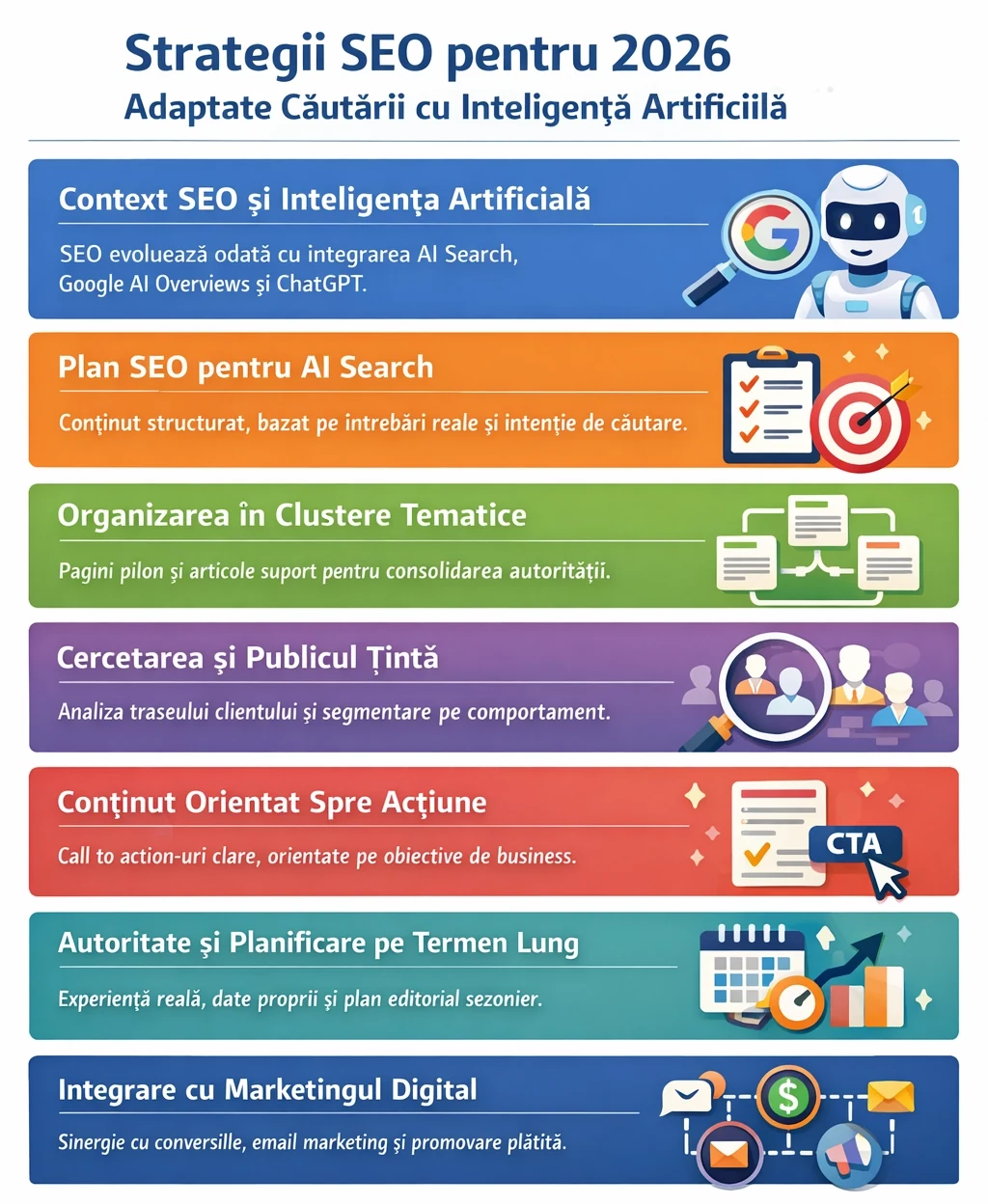
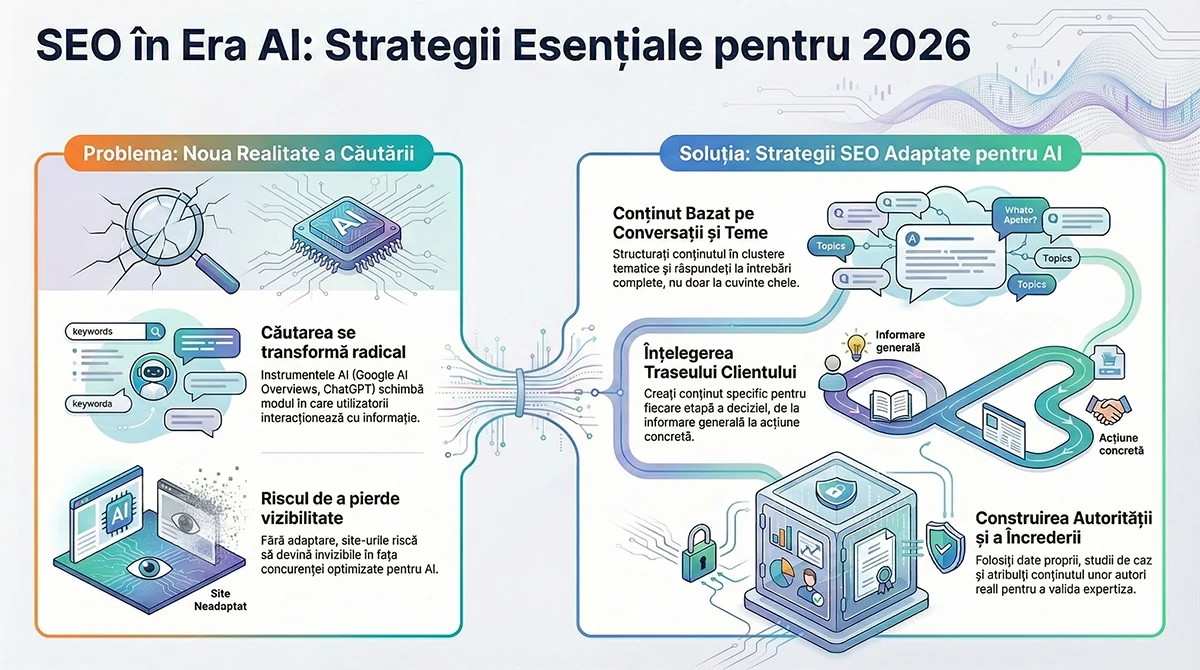
Currently, SEO no longer works exclusively based on traditional Google ranking rules. The integration of artificial intelligence in search engines, the emergence of Google AI Overviews and the increasingly frequent use of conversational tools like ChatGPT are changing how users access information.Nevertheless, organic traffic remains an important pillar for websites that pursue stability and long-term growth. For our website, for example, this change represents an opportunity. By adapting content to the new requirements of AI Search, visibility can be strengthened both in classic Google results and in responses generated by artificial intelligence.
Why a dedicated SEO plan for AI Search is necessary
An SEO plan oriented towards AI Search does not replace traditional optimization, but complements it. AI tools analyze content structure, clarity of explanations and relevance of information in relation to user questions. If your website is not structured to respond coherently and completely to these requirements, you risk losing visibility to the competition. For us, such a plan involves identifying main topics in the SEO field, digital marketing and automation, followed by developing materials that explicitly answer real questions formulated by users.Content based on conversational questions and real intent
Users no longer search for simple terms. Questions are longer, more detailed and more solution-oriented. Therefore, keyword research must be extended towards intent analysis. Content created for your website must clearly answer questions such as:- how SEO optimization works in 2026
- how artificial intelligence influences Google results
- what SEO strategies are effective long-term
Structuring content in thematic clusters
A central element of modern SEO strategy is organizing content in thematic clusters. For https://www.goai.ro, this involves creating pillar pages that address broad topics, such as SEO, digital marketing or automation, supported by detailed articles on subtopics. This structure helps search engines understand the website's authority on a particular topic and provides clear context for AI tools. Internal links between pillar pages and supporting content consolidate relevance and improve user experience.SEO research related to the customer's decision journey
Effective SEO doesn't just mean attracting traffic, but attracting the right users. For this, it's necessary to understand the customer's decision journey. Initially, users search for general information. Later, they look for comparisons, detailed explanations and finally, concrete solutions. Dedicated content must be created for each stage. The website https://www.goai.ro can cover these stages through educational articles, case studies and well-structured service pages that naturally guide the user towards a decision.
Audience profiles defined by behavior and motivation
Audience segmentation exclusively on demographic criteria is no longer sufficient. Understanding motivations, objections and search behavior is necessary. Some people seek validation through concrete examples, others are interested in technical explanations or excellent results. Content published on our website, for example, must take these differences into account. Language, structure and depth of information must be adapted to meet the needs of each type of user.The role of action-oriented content
Currently, content must support business objectives. Informational pages must include clear actions, relevant to the subject. For your website, these actions can include requesting an SEO audit, quote requests or direct contact with an SEO company. The proposed action must be logically linked to the information presented. Thus, the user doesn't perceive the call to action as an advertisement, but as a natural step in continuing the information process.Seasonality and long-term content planning
Even in the digital services domain, there is seasonality. Interest in SEO optimization, online marketing or automation can vary depending on periods of the year, algorithm changes or economic context. An effective editorial plan for your website must take these variations into account. Publishing and updating content before periods of increased interest helps gain a competitive advantage and maintain online visibility.Building authority through experience and proprietary data
Generic content is no longer sufficient to support long-term positioning. Authority is built through real experience, concrete examples and proprietary data. Your website can consolidate this authority by presenting processes used, results obtained and case studies. Data obtained through internal analyses or real projects can become reference points. This information is appreciated by both users and AI tools that seek credible sources.Content attribution and transparency
An important element for building trust is attributing content to real people. Presenting authors, their roles and experience contributes to information validation. This transparency is beneficial both for users and for search engine evaluation algorithms.Integrating SEO with other digital marketing components
SEO works best when integrated with other channels. Optimized content must be supported by conversion optimization, email marketing and, where applicable, paid promotion. For your business, this integration allows leveraging each visitor and increasing the overall efficiency of the strategy.Strategic directions for implementation
To achieve excellent results in 2026, it's necessary to approach SEO as a strategic process. Structure content by topics, understand audience behavior, integrate conversion-oriented elements and invest in authority and real experience. This approach ensures stable visibility both in Google and in results generated by artificial intelligence.How this article was made
- Author
- Dorel Tănase
- Published
- 4 January 2026
- Last updated
- 18 September 2026
- Sources
We work by our publishing principles, corrections policy, ethics policy.